

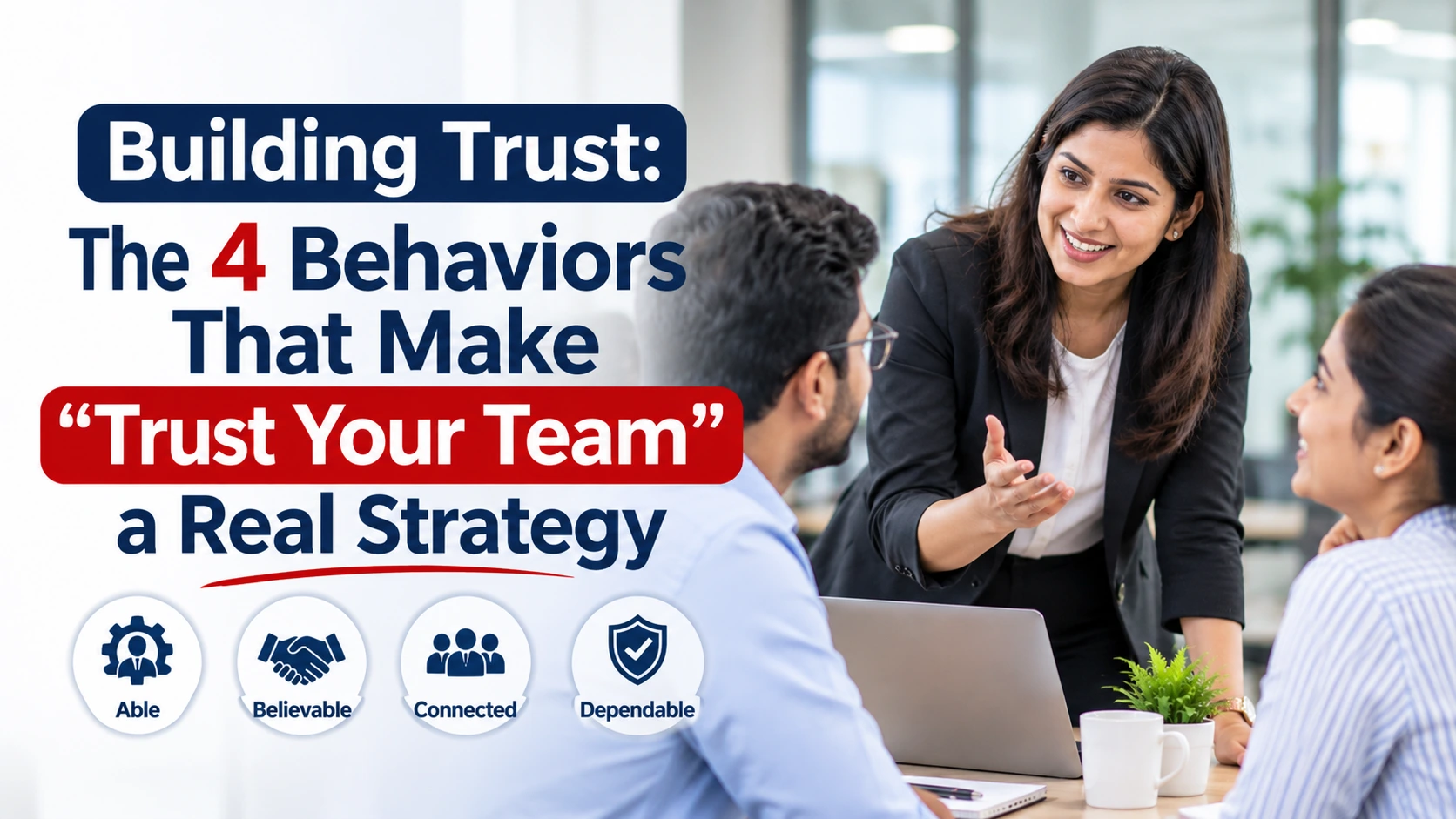
The act of creating trust involves the repeated demonstration of these four traits: ability, believability, connectedness, and dependability. As leaders display these qualities, “trust your team” ceases to be just a tagline and becomes a strategy for getting work done.
Most leaders say they trust their people. Fewer can explain what that trust rests on, or what to do when it cracks. This guide breaks building trust into observable actions you can practise, measure, and repair.
What Does Building Trust Mean at Work?
Workplace trust can be developed when there is a capacity for you to create consistent patterns of behavior which will enable workers to take risks, share negative information quickly, and delegate without fear. Trust is not an emotional feeling that is natural. Trust is an evaluation of your behavior, consistently conducted by other people.
This is a process that occurs in small details, such as giving credit to whom it is due, taking responsibility for your own mistakes, or making that call that you promised to make. This is why creating trust in the workplace is a leadership skill, and not a matter of personality. Skills can be developed, practiced, and improved. Personalities don’t fit into a schedule.
Also Read: Why and How To Build Trust in the Workplace
Why Building Trust in the Workplace Matters Now
Trust has turned out to be the key element that will determine whether or not strategies can get implemented in practice. Employees continue to give more trust to their company than to most other organisations. According to the 2026 Edelman Trust Barometer, 78% of employees trust their employer, making it the most trusted institution in the study.
This is a strength, but a fragile one. Trust, which is taken for granted rather than earned, will be destroyed with the first broken promise or injustice felt.
The performance gap is real. In his research published in Harvard Business Review, neuroeconomist Paul Zak found that people at high-trust companies report 50% higher productivity than those at low-trust companies. Building trust in the workplace is therefore not a “soft” agenda. It is an operating advantage.
When trust is low, the costs are quieter but constant:
- Decisions should be made at once but are escalated to higher levels.
- Information is kept private instead of being shared.
- There is too much micromanagement because the manager is unable to predict the outcome.
- The good employees tend to leave the organization, mostly due to their manager.
The 4 Behaviors That Build Trust: The ABCD Model
Analyzing the behaviors that create trust can be achieved effectively using the ABCD theory for trust as suggested by Blanchard. The theory classifies behaviors of trust into four categories, which include Able, Believable, Connected, and Dependable. The four elements are questions asked mentally.
Element | The question people ask | What it looks like in practice |
Able | Can you do the job? | Competence, results, sound judgement |
Believable | Do you act with integrity? | Honesty, fairness, consistency with values |
Connected | Do you care about me? | Listening, sharing information, recognition |
Dependable | Will you do what you say? | Follow-through, accountability, responsiveness |
Lack of competence in any one of them can weaken the others. A brilliant manager who fails to keep promises will lack trustworthiness. A charming manager who cannot deliver will be liked but not trusted.
1. Able: Demonstrate Competence
Being “able” implies that others see you as having the skills, qualifications, and experience needed for the job. Competence is the basic qualification for trustworthiness.
Behaviors that show you are Able:
- Ensure that your achievements are measurable for your group.
- Address issues rather than simply transferring them to someone else.
- Continue growing and know what you don’t know.
- Enable people to build their skills.
For leaders, being Able also means building capability in others. Trust grows when people see you investing in their growth, not just your own output.
2. Believable: Act with Integrity
Believability is the quality of being truthful to oneself in what one says, does, and is. Leaders are respected because they can tell the truth even when it isn’t convenient to do so.
Behaviors that show you are Believable:
- Speak the truth, even when it is difficult.
- Fess up to errors promptly and without excuse.
- Be fair to others and treat all people equally.
- Respect confidences and refrain from gossiping about other people.
A person’s integrity is tested most when under pressure. A manager who safeguards the reputation of his or her team in case of failure will gain much more respect than one who passes the blame up.
3. Connected: Show That You Care
Being Connected means people feel you see them as individuals, not just as resources. This is the element leaders most often underestimate.
Behaviors that show you are Connected:
- Listen fully before you respond.
- Share information openly so people are not left guessing.
- Recognise contributions specifically and promptly.
- Show interest in people’s goals beyond their current task.
It is particularly relevant in hybrid and virtual environments because informal contacts are rare in these cases. Establishing trust in teams that seldom meet face-to-face is the responsibility of leaders who must facilitate informal contacts.
4. Dependable: Follow Through
Dependability refers to a characteristic of individuals who can be depended on to deliver on their promises. It transforms good intentions into trust.
Behaviors that show you are Dependable:
- Make promises you can keep and keep your word.
- Give a reply promptly; even if it’s ‘not yet.’
- Be organized so that others are not held back by you.
- Should anything slip through the cracks, take responsibility for it.
Dependability compounds. Each kept promise makes the next request easier to say yes to.
Why leaders are especially exposed
Seniority ups the ante. When the leader becomes “a winner,” everyone close to him or her has all the reasons in the world to become “minimizers.” And over time, this is going to result in a management cadre receiving only filtered information. In such a situation, the leader is convinced he or she is well-informed while being oblivious to key facts. The first safeguard is awareness, which the Conversational Capacity® framework describes as recognising when fight-or-flight reactions block real listening and create discomfort in others.
Signs of Low Trust in a Team
Low trust rarely announces itself. It shows up as friction that leaders often misread as a performance or process problem. Watch for these warning signs:
- Agreement all around at meetings, with subsequent side conversations.
- Subordinates always copy their managers on emails to cover their butts.
- Hesitant answers when you seek feedback.
- Over-checking work that ought to be routine.
- The flow of new ideas stops entirely, especially from your best people.
Each indicator is normally an indicator of a particular element. Guarded responses are often an indication of an absence of Believable or Connected. Continuous protection of oneself is normally an indication of an absence of Dependable.
Also Read: 7 Warning Signs That Distrust Is Harming Your Organization
Common Mistakes That Erode Trust
Even well-intentioned leaders weaken trust without noticing. The most common mistakes are rarely dramatic. They are small habits repeated often:
- Overpromising: It is tempting to say “yes” to everything, but broken promises hurt Dependability more than saying “no.”
- Withholding the context: Discussing choices without their underlying logic leaves people guessing and harms Connected.
- Double standards: Being accountable for some people and not being for others hurts believability throughout the entire team.
- Claiming the credit, taking the blame: There are few actions that harm trust more than a leader who takes credit for successes and gives out blame.
- Ignoring the hard conversations: Not addressing performance problems is either an indication of incompetence or lack of concern.
Fixing these habits is often the fastest route to building trust in teams, because it removes the daily friction people feel most.
How to Build Trust in Teams: A Practical Playbook
It starts with understanding the model. It is only through its application each day that trust between team members can be gained. This is how you can build trust within the four steps.
- Assess yourself first: Score yourself honestly on Ability, Believability, Connectedness, and Dependability. Then have two to three members of your team score you too. These differences indicate areas of improvement.
- Create a common vocabulary for trust: Once your team learns the four components of trust, your feedback will be very specific. “I need to be more connected with you” is much clearer than “You cannot be trusted.”
- Give trust first: Assign tasks that have measurable results and come with a true level of responsibility.
- Follow up on all commitments made: Document all the promises you make through one-on-ones and team meetings. Follow up on those promises, even if you are reporting an extension on the promised date.
- Schedule regular trust review sessions: Inquire from your team what makes them feel more trusted and what hinders their feelings of trustworthiness. Consider the feedback as just that – feedback.
The skill of building trust is something more than an activity that can be acquired by attending a session once in a lifetime.
How to Rebuild Trust When It Breaks
Trust violations are bound to happen within any community of individuals. There is a missed deadline, trust has been broken, or a misunderstanding has taken place. It is just as important to learn how to rebuild trust as it is to build it.
Here is how to rebuild trust in a structured way:
- Admit the mistake: Describe the broken rule directly. Do not use downplaying words or vague apologies.
- Describe which rule was violated: Was it a competency failure (Able), an honesty issue (Believable), an empathy issue (Connected), or a dependability failure (Dependable)? It will be necessary to understand where the problem is to solve it.
- Make an apology and accept responsibility for the problem: An honest apology should be made focusing on the effect it had on other people, and not on your intention to do the wrong thing.
- Come to an agreement about how to solve the problem: You should ask the other party what could be done to regain their trust.
However, the hardest part of rebuilding the capacity to rebuild trust is being patient. It is through the pace of the other person that the process of trust will be regained, while your role is just to keep on doing the right thing.
Making “Trust Your Team” a Real Strategy
“Trust your team” will become a strategy once the concept of trust is clearly understood, practiced, and enforced throughout the organization. This involves three changes:
- Behavioral intentions: Leadership training focuses on particular behavioral traits that promote trust instead of being told to be trustworthy.
- Individual to system: Performance management discussions, orientation, and leadership development all speak the same language of trust.
- Reaction to prevention: Teams measure their levels of trust continuously rather than after the situation occurs.
Strategy requires ownership as well. Senior leadership must demonstrate the four aspects in public, HR must incorporate them into the recruitment and promotion criteria, and line managers must discuss trust in addition to performance in team reviews. If everybody owns trust, then trust will no longer be dependent on the few naturally trusted individuals.
Organisations that treat building trust as a capability, rather than an outcome, give their managers a shared framework and the skills to use it. A structured Building Trust program can help leaders and team members learn the ABCD behaviors, diagnose low-trust relationships, and repair them when they break.
Frequently Asked Questions
What are the 4 behaviors that build trust?
The four behaviors that create trust are being Able, Believable, Connected, and Dependable. Able stands for competence, Believable stands for integrity, Connected stands for caring, and Dependable stands for accountability. Together, these behaviors make up the ABCD Trust Model.
How do you build trust in the workplace quickly?
Begin with small promises and clear communication. Trust in the workplace develops faster when there is a pattern of follow-through and updates, as well as a desire for the person’s success. There is no other way to do it.
How do you build trust in a new team?
Understand the goals of each individual, let them know your own working style, and set up expectations from the start. Creating a feeling of trust within new teams requires predictability, and this means you must make your decision-making and communication processes clear.
What is the first step in how to build trust as a new manager?
Listen first before taking any action. Listen in the first couple of weeks to how they operate, how they get frustrated, and what they want from you. After that, take on one or two commitments and follow through. This will be the backbone for everything else that follows.
Does trust training work for teams, or only for leaders?
It will work for both. The leaders have an important influence on creating such an environment, but it is also created by peers as well. When everybody uses the same approach, it will be easier for team members to criticize each other constructively.
Why is building trust important for leaders?
Leaders depend on others to get things done. Without trust, people will not try very hard and will withhold their thoughts and negative information. Building trust gives leaders the discretionary effort and honesty needed for performance.
How long does it take to rebuild trust?
However, there is no specific duration required for this, based on the magnitude of the breach and the trustworthiness of the individual even after the breach. Small breaches may take a few weeks to overcome, whereas large breaches require months of effort.
Can trust be measured?
Yes, trust may be assessed through trust assessments or surveys whereby individuals rate one another in respect to the ABCD components. With time, shifts in ratings will reflect whether or not behavior related to trust has been made into a habit.
What is the difference between trust and psychological safety?
Trust is an assessment of the reliability and intentions of an individual. Psychological Safety is a shared belief that the team environment is safe for interpersonal risk-taking. Trust among the leaders and the team members acts as the very foundation of psychological safety.
What role does communication play in building trust?
Communication is the method that allows the four characteristics to be seen. Communication shows your Believable and Connected nature, while constant communication of your progress will make you Dependable. Trust is generally not broken in a team over one communication but gradually due to lack of communication and surprise.