

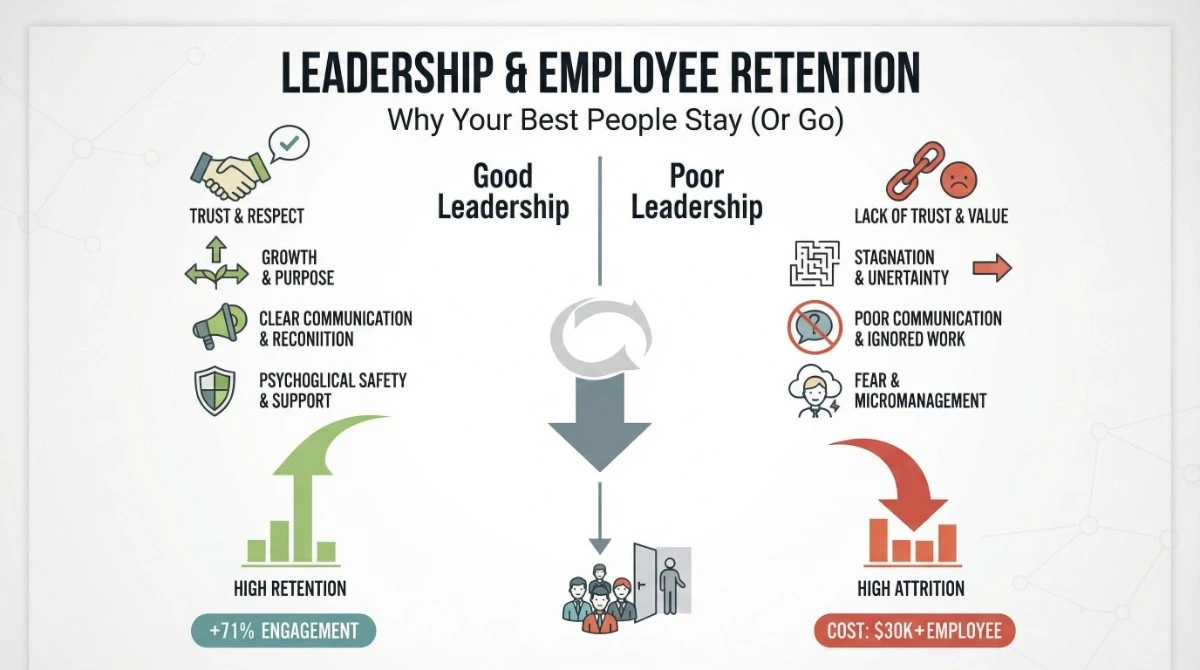
People don’t leave the company; they leave the managers. A lot of people in business say this, but many companies still don’t think about leadership when they try to fix a problem with high turnover. The truth is that the quality of your leadership is what will keep your best workers from leaving or quietly updating their resumes.
If you go into a company that does well, you’ll see that the managers really care. They pay attention, follow through, give credit where it is due, and make people feel like their work is important. That wasn’t an accident. It’s the result of high-quality, intentional leadership, and it has a huge effect on retention.
This blog unpacks exactly what is the relationship between leadership and employee retention? and explores why investing in your leaders might be the single most powerful thing your organization can do to stop the revolving door.
The Real Cost of Getting Leadership Wrong
Let’s start with a number that tends to make CFOs pay attention. Replacing a single employee costs Canadian employers an average of $30,674 per year ,and that’s before factoring in hidden costs: lost institutional knowledge, lower team morale, reduced productivity during the transition, and the time managers spend re-hiring instead of doing their actual jobs.
71%
of Canadian employees surveyed reported considering leaving their jobs ,a sobering reminder that talent retention is no longer optional.
High attrition rarely comes down to salary alone. Stress, lack of recognition, poor communication, and feeling undervalued are consistent exit-interview themes. And the common thread running through almost all of them? Poor leadership quality. When leaders fail to connect, motivate, and support their teams, people walk ,often to a competitor who will.
What Is the Relationship Between Leadership and Employee Retention?
The connection is direct and well-documented. Effective leadership creates psychological safety, a sense of purpose, and a feeling of being genuinely valued ,all of which are powerful predictors of whether an employee chooses to stay. On the flip side, toxic, inconsistent, or disengaged management is one of the fastest ways to push talented people out the door.
You feel respected when your boss sees how hard you work, helps you grow, and trusts you to get things done without having to micromanage every step. Because the company has shown that it cares about your success, you care about the company’s success as well. People stay committed through tough times—missed bonuses, changes in the organization, and stressful quarters—because of that emotional contract.
Effective leadership also sets the cultural tone for an entire department or organization. Leaders model the behaviours that become normalized. If a manager handles conflict openly and fairly, their team learns to do the same. If they celebrate wins and take accountability for losses, that mindset permeates the team. Over time, this builds a culture where people genuinely want to show up ,and that’s the most sustainable retention strategy there is.
Read More – What is Leadership? Definition, Significance and Theories
How Do Leadership Styles Affect Employee Turnover?
Not all leaders are built the same, and their approach has a measurable effect on whether their teams stay or go. How do leadership styles affect employee turnover? The answer depends largely on how much autonomy, respect, and vision the style provides.
1. Transformational Leadership
Transformational leaders are the gold standard for retention. They connect employees to a bigger purpose, invest in personal growth, and inspire people to exceed their own expectations. The leadership style impact here is profound: turnover drops because people feel their work has meaning and their leader actively champions their future within the organization.
2. Democratic and Participative Leadership
Leaders who bring their teams into the decision-making process send a clear message: your opinion matters here. This approach builds trust and ownership in a way that top-down management simply cannot. The leadership style impact on retention is consistently positive when leaders create space for genuine dialogue.
3. Visionary Leadership
Visionary leaders give people something to work towards. By articulating a compelling picture of where the organization is headed and how each role contributes to that journey, they create a sense of belonging and forward momentum. This is one of the most underrated drivers of long-term loyalty.
4. Delegative Leadership
Effective leadership often involves knowing when to step back. Delegative leaders empower their people by giving them genuine ownership over their work. This builds confidence and job satisfaction. When employees feel trusted and capable, they have far less reason to look elsewhere for fulfilment.
5. Coercive and Micromanaging Leadership
On the other end of the spectrum, coercive leadership ,marked by rigid control, public criticism, and a refusal to trust team members ,is a near-guaranteed recipe for high attrition. The leadership style impact is stark: employees under authoritarian managers consistently report lower morale, higher stress, and a stronger desire to leave.
Impact of Leadership Quality on Team Engagement and Loyalty The impact of leadership quality on team engagement and loyalty goes far beyond surface-level satisfaction scores. When leaders are consistent, fair, communicative, and genuinely invested in their people, they build emotional equity. Employees don’t just tolerate their job ,they feel a stake in its success. Gallup research has consistently found that managers account for at least 70% of the variance in employee engagement scores. High engagement means more discretionary effort, lower absenteeism, better team collaboration, and ,critically ,far lower turnover.
The Qualities That Define Strong, Retention-Focused Leadership
Leadership quality isn’t a vague, intangible concept ,it shows up in specific, everyday behaviours. The leaders who retain their best people tend to share a recognizable set of traits.
1. Clear, consistent communication
They share goals, explain decisions, and don’t leave their teams guessing. Leaders who communicate openly give their teams a sense of stability even in uncertain times.
2. Recognition and appreciation
Effective leadership means acknowledging effort ,not just results. A quick, genuine “great work on that presentation” can mean the difference between an employee who feels seen and one who quietly starts wondering if their contribution even registers.
3.Investment in development
Employees want to grow. When leaders actively support their team’s professional development ,through stretch assignments, training, mentorship, or honest feedback ,they signal that the relationship is long-term.
4. Psychological safety
Teams with high psychological safety are more innovative, more resilient, and more loyal. This is one of the most important gifts a leader can give their team: the ability to speak up, make mistakes, and share ideas without fear.
5. Leading by example
Leadership quality is ultimately about integrity. Leaders who model the values and work ethic they expect from their team earn a level of respect that is genuinely hard to walk away from.
Strengthen Leadership. Reduce Attrition. Retain Your Best Talent.
High performing teams start with high-quality leaders. Invest in leadership development programs that build communication, emotional intelligence, and accountability, so your people choose to stay and grow with you.
Explore Leadership Development SolutionsGood Practices vs. Bad Practices: A Quick Reference
| Good Leadership Practices | Practices That Drive People Away |
|---|---|
|
Transparent, regular communication |
Secrecy, withholding information, mixed signals |
|
Genuine recognition and appreciation |
Ignoring achievements; taking credit for others’ work |
|
Empowering employees with autonomy |
Micromanaging every task and decision |
|
Investing in coaching and development |
Offering no growth path or learning opportunities |
|
Supporting work-life balance |
Normalizing overwork and burnout |
|
Creating psychological safety |
Blame culture; punishing honest mistakes |
|
Building genuine relationships |
Emotional distance and indifference to team wellbeing |
Retention Strategies That Start With Leadership
When organizations try to address attrition with perks ,free lunches, gym memberships, flexible hours ,without addressing underlying leadership quality, they’re treating the symptom, not the disease. Retention strategies that actually work must be rooted in how people are managed day to day.
One of the most effective retention strategies is leadership development at every level. Organizations that invest in training their managers ,not just technical skills, but emotional intelligence, communication, coaching, and conflict resolution ,see measurable improvements in engagement and turnover.
A third key retention strategy is holding leaders accountable for retention outcomes. If a manager consistently loses good people, that needs to be part of their performance conversation ,not just revenue targets or project delivery metrics. When leadership quality is measured and rewarded, it improves.
The Hidden Toll on the Teams Left Behind
When talented team members resign ,especially repeatedly ,the remaining team notices. They start to ask themselves: if my colleague, who was great at their job and clearly committed, decided to leave, what does that say about this place?
Effective leadership understands this ripple effect. Turnover isn’t just a cost in time and money ,it’s a signal that travels through the whole organization. And conversely, when leaders create an environment where people genuinely want to stay, that sends an equally powerful message.
The leadership style impact on collective morale and team cohesion shows up in every performance metric ,productivity, innovation, collaboration, customer satisfaction. Leadership quality isn’t just a people issue. It’s a business performance issue.
Read More – The importance of leadership development in modern business
Building a Leadership Culture That Retains Top Talent
Lasting retention doesn’t come from a single initiative. It comes from building a culture where effective leadership is the norm, not the exception. That means hiring for leadership potential, not just technical competence. It means developing leaders continuously, not just when a problem arises.
The leadership style impact on retention compounds over time. A team that has been led well for two or three years develops deep trust, strong communication habits, and a shared sense of identity. Those teams become remarkably resilient to the usual forces of attrition.
The question isn’t whether leadership quality matters for retention. The evidence on that is unambiguous. The question is whether your organization is willing to make the investment ,in training, in accountability, in culture ,to develop leaders who truly earn the loyalty of their people.