
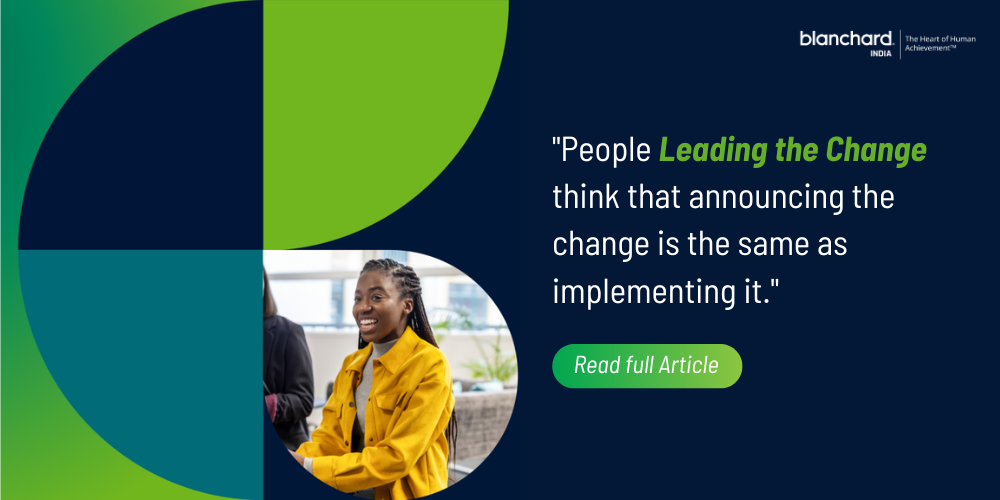
Most organisations don’t fail at change because they lack ambition. They fail because they confuse announcing change with implementing it. If you have ever watched a well-intentioned transformation initiative quietly stall within months of launch – budget approved, slides done, email sent – you already know this is not a resource problem. It is a leadership problem. And it is one that a structured approach to organisational readiness for change can solve.
The good news: when leaders learn to surface and address people’s predictable concerns, resistance drops, advocacy grows, and results arrive faster. That is the promise at the heart of Blanchard’s Leading People Through Change® programme – and the subject of our upcoming complimentary webinar on June 3, 2026.
Why 70% of Change Initiatives Fail - and What the Research Actually Shows
The statistic has become almost cliché, but the research behind it still deserves serious attention. According to studies cited in Blanchard International’s white paper Leadership Strategies for Making Change Stick, as many as 70 percent of all change initiatives fail. Two reasons account for the majority of those failures:
The second reason is equally damaging: people’s concerns with change are not surfaced or addressed. They may comply early on, but unresolved concerns cause them to revert to old behaviours the moment pressure eases.
A Ken Blanchard Companies study of more than 900 training and HR leaders found that 55% of organisations rely on an internal cross-functional team to manage change – and only 14–25% seek outside expertise. More striking: the top challenges cited were engaging employees (48%), sustaining momentum (48%), and building leadership bench strength to support the process (47%). These are not execution failures. They are leadership readiness failures.
In the Indian context, where organisations are navigating simultaneous pressures – competitive disruption, workforce transformation, post-pandemic culture recalibration – the need for a change management readiness assessment embedded in a structured leadership approach has never been more urgent. Organisations in GCC, IT, healthcare, and SaaS sectors are discovering that change without a readiness framework is simply organised chaos with a communication plan attached.
What Is Organisational Readiness for Change - and Why Most Leaders Skip It
Organisational readiness for change is not a sentiment survey or a one-time diagnostic. It is a continuous leadership practice – the ability to diagnose where people are in their change journey, understand their specific concerns, and match your leadership response accordingly. A readiness change assessment done well gives leaders a map. Without it, they are navigating blind.
The tendency in most organisations is to move straight from decision to deployment. Leadership team aligns. Communications are drafted. Training is scheduled. But the people being asked to change – middle managers, team leads, frontline contributors – are still at step zero: they do not understand why this change is happening, what it means for them personally, or how they are expected to operate differently starting Monday.
Blanchard’s research makes the point directly: people are not resistant to change – they are resistant to being controlled. When organisations try to sell change to people instead of involving them, they doom their initiatives from the start.
The Six Stages of Concern - A Framework Every Change Leader Needs
Blanchard’s Leading People Through Change® programme is built on a model that distinguishes it from most change management frameworks on the market: it diagnoses before it prescribes. At the centre of this approach are the Six Stages of Concern – a research-backed sequence that people move through whenever they are asked to change.
Stage 1: Information Concerns
At the outset, people want specifics. What is changing? Why? What is wrong with the current approach? Leaders often underestimate how much people need the honest business case – not a polished narrative, but a real answer. The right assumption here, as Blanchard’s framework notes, is that people are smart: if they had access to the same information leaders have, they would reach the same conclusions.
Stage 2: Personal Concerns
This is the most commonly ignored stage – and the most dangerous to skip. People want to know: Will I win or lose? Will I need new skills? How does this affect my day-to-day? If leaders do not address personal concerns near the beginning of the change process, people may comply temporarily but will not commit the discretionary energy needed to sustain the change. This is where most Indian leadership teams lose momentum – the announcement lands, but the personal dimension is never addressed.
Stage 3: Implementation Concerns
What do I do first? Where do I get help? How long will this take? Implementation concerns are practical and immediate. Leaders who do not provide clear, step-by-step guidance at this stage find their people improvising – and improvisation under pressure usually defaults to old behaviour.
Stage 4: Impact Concerns
Is this making a difference? Is the effort worth it? At this stage, if leaders have done the work in the first three stages, people will begin to sell themselves on the change. They are open, willing to advocate, ready to evaluate on merits.
Stage 5: Collaboration Concerns
People who have moved through earlier concerns now want to spread what is working. Who else needs to be involved? How do we break down silos? This is where grassroots advocacy becomes a real organisational force – if leaders create the conditions for it.
Stage 6: Refinement Concerns
The final stage is about continuous improvement. Employees are asking what could work better and want a role in evolving the approach. The leader’s job here is to encourage this refinement and invite others to challenge the status quo constructively.
Understanding these stages is what turns a change management readiness assessment from a static survey into a dynamic leadership practice. When leaders can identify where each person is in this sequence, they can communicate the right information at the right time – which, per Blanchard’s research, is the single most reliable way to lower resistance and increase buy-in.
Five Change Leadership Strategies That Actually Move People
Blanchard’s LPTC framework maps five change leadership strategies to the stages above. This is what leadership change management training should actually equip leaders to do – not just understand the theory, but match their response to where people are.
- High Involvement (Buy-In): Increase the level of influence and involvement from the people being asked to change. This is not a one-time gesture – it must be applied relentlessly throughout the process.
- Explore Why Change Is Needed (Compelling Case): Build an evolutionary rationale – one that ties the change to the organisation’s past successes rather than implying past approaches were wrong. Create a vision clear enough that people can see themselves in the future state.
- Collaborate on Implementation (Right Resources): Break down walls between departments. Define metrics, accountability, and quick wins. Plan for what could go wrong before it does.
- Make the Change Sustainable (Sustainable Results): Accountability is the key. Measure impact, share wins in real time, remove obstacles, and anchor new behaviours into the culture.
- Explore Possibilities (Options): Involve people from the beginning in assessing the status quo and selecting the approach. Change done with people, not to people, is change that sticks.
Blanchard India’s data further shows that organisations that implement a structured, high-involvement approach can reduce implementation time by 33% and increase employee engagement by 38%. These are not marginal gains – they represent the difference between a change initiative that delivers ROI and one that quietly becomes a case study in what not to do.
What Makes a Readiness Change Assessment Actually Useful
A change readiness report is only as useful as the leadership response it triggers. Too often, organisations invest in diagnostic tools but then treat the results as informational rather than actionable. The Blanchard model is built around three critical change leadership skills that bridge the gap between assessment and action:
- Diagnosing: The willingness and ability to look at a situation and assess the concerns of the people being asked to change.
- Matching: The ability to deploy a range of change leadership strategies fluidly, providing individuals with what they need at each stage.
- High Involvement: The willingness to partner with the people being asked to change – surfacing their concerns, including them in decisions, and increasing their commitment.
This is the foundation of organizational change readiness as a leadership capability – not a checklist, but a muscle that leaders develop over time with the right framework and practice. And it is exactly what the Leading People Through Change® programme is designed to build.
What Effective Change Leadership Looks Like in Practice
Consider a common scenario in Indian organisations right now: a large GCC or IT firm rolling out a new performance management system. The CHRO has signed off, the HRIS vendor has been selected, and the IT team is ready. But the people managers – the ones who will actually use the system and coach their teams through it – are somewhere between confused and quietly resistant.
A top-down rollout treats this as a communication problem. Send more emails. Schedule more town halls. But the real problem is that nobody has addressed what is actually going on in the minds of those managers: Will this make me look bad if my team scores poorly? What happens to my current way of doing things? Who do I call when something breaks?
These are Stage 2 and Stage 3 concerns – Personal and Implementation – and they will not be resolved by a polished presentation. They require deliberate leadership attention, structured conversations, and the kind of high-involvement approach that Blanchard’s LPTC programme teaches.
This is also where the leadership change management training distinction matters. Generic change management frameworks tell leaders what to do. Blanchard’s LPTC teaches leaders how to read people – how to diagnose concern stages, how to respond with the right strategy, and how to build the organisational capacity to manage change not just this time, but every time.
About Leading People Through Change® by Blanchard India
Leading People Through Change® is a globally proven leadership development programme delivered in India by Blanchard India – a BYLD Group company and authorised partner of Blanchard International. The programme is available in-person, virtual instructor-led, and online formats, and is used by organisations across GCC, IT, healthcare, and professional services sectors to build sustainable change leadership capability at all levels.
FAQs
1. What is organisational readiness for change?
Organisational readiness for change refers to an organisation’s ability to prepare, equip, and support its people to successfully adopt change. It involves assessing employee mindset, leadership alignment, and operational preparedness to ensure smooth implementation and long-term sustainability.
2. Why do most change initiatives fail in organisations?
Most change initiatives fail because organisations focus more on announcing change rather than implementing it effectively. As highlighted in the article, lack of leadership involvement and failure to address employee concerns are the primary reasons behind unsuccessful transformations.
3. What is a change management readiness assessment?
A change management readiness assessment is a structured approach used to evaluate how prepared an organisation and its employees are for change. It helps leaders identify gaps, understand employee concerns, and design targeted strategies to improve adoption and engagement.
4. How can leaders improve employee buy-in during change?
Leaders can improve employee buy-in by involving people early in the process, addressing personal concerns, communicating clearly, and providing the right resources. High involvement, continuous dialogue, and stage-based leadership responses significantly reduce resistance and increase commitment.